

1
20 Science Books That Changed How I See the World
I like to understand the world, I think being curious about how things work makes life more interesting and fun! There are so many science books you can enjoy without having a scientific background, just some curiosity and a willingness to have your assumptions challenged.
The list below are some of my favourites, covering everything from the origins of the universe and the workings of the human body to mathematics, psychology, and the discoveries that have shaped modern life. Some explain complicated ideas while others tell stories of the people behind them. Every one of these books left me looking at the world differently!


2

Behave
Behave by Robert M. Sapolsky explores the complex biological, environmental, and social factors that influence human behaviour. The book delves into the workings of the brain and how our actions are shaped by a combination of genetics, neurology, and evolutionary history, providing a comprehensive look at what drives us to behave the way we do. It's an insightful journey into the science of human nature.
3

Humble Pi
In Humble Pi, Matt Parker explores the fascinating world of mathematical mishaps and errors throughout history. The book highlights the surprising and sometimes humorous consequences of mathematical mistakes in various fields, showing the critical role maths plays in our everyday lives.
4
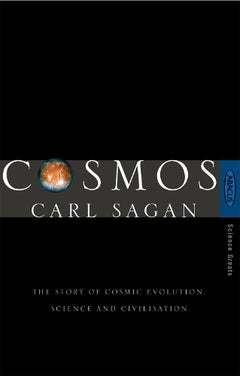
Cosmos
Cosmos by Carl Sagan is a compelling journey through the universe, exploring the origins of life, human evolution, and the vastness of space. It delves into scientific concepts with accessible explanations, showcasing the wonder and intricacy of the cosmos while reflecting on humanity's place within it.
5

Astrophysics for People in a Hurry
6

The Body
In The Body by Bill Bryson, the author embarks on a fascinating exploration of human anatomy, delving into how the body functions and its remarkable capabilities. Through a blend of science, history, and humour, Bryson provides insights into the intricate systems that keep us alive, making complex concepts accessible and enjoyable.
7

Guns, Germs and Steel
Guns, Germs, and Steel by Jared Diamond explores the historical and environmental factors that have influenced the fates of different societies. It examines how geography, agriculture, and technology shaped the modern world, leading to European dominance. The book integrates science and history to explain why some civilizations advanced faster than others.
8

A Short History of Nearly Everything
A Short History of Nearly Everything by Bill Bryson is a captivating exploration of science and the discoveries that have shaped our understanding of the universe. It distils complex subjects, from the Big Bang to quantum mechanics, into engaging and accessible narratives, offering a panoramic view of scientific knowledge. Bryson's wit and curiosity make the journey both enlightening and entertaining.
9

How to Invent Everything
How to Invent Everything by Ryan North is a humorous and informative guide that imagines you're stuck in the past without modern technology. It provides step-by-step instructions for recreating essential inventions and innovations from agriculture to chemistry, ensuring you're ready to rebuild civilization from scratch with wit and scientific insights.
10

How to Solve It
How to Solve It by George Polya is a classic work in mathematics education that provides a step-by-step guide for solving mathematical problems. It breaks down problem-solving into four principles: understanding the problem, devising a plan, carrying out the plan, and looking back. Polya's methods are not just for maths but can also be applied to real-life problem-solving.
11

Six Easy Pieces
Six Easy Pieces is a compilation of lectures by renowned physicist Richard Feynman that covers fundamental topics in physics, including atoms, basic physics concepts, energy conservation, and the relation of physics to other sciences. Edited by Matthew Sands and Robert Leighton, it presents complex ideas in an accessible and engaging manner, perfect for beginners and enthusiasts alike.
12

A Brief History Of Time
A Brief History of Time by Stephen Hawking explores the nature of the universe, touching on complex topics like the Big Bang, black holes, and the nature of time itself. Hawking presents these ideas in a way that is accessible to non-scientists, aiming to answer fundamental questions about our existence.
13

Longitude
Longitude by Dava Sobel tells the fascinating story of John Harrison, a self-taught clockmaker who solved the age-old problem of determining longitude at sea. His innovative timepieces revolutionised navigation, transforming maritime travel and saving countless lives. This book blends history, science, and biography into a captivating narrative.
14

Seven Brief Lessons on Physics
Seven Brief Lessons on Physics by Carlo Rovelli offers a concise and accessible exploration of the fundamentals of modern physics. It covers significant scientific breakthroughs, from Einstein’s theory of relativity to quantum mechanics, in a way that is engaging and understandable for general readers. This book provides a poetic and thought-provoking overview of how the universe works.
$2300
$2600
Elsewhere:
Unit price
/
Unavailable
Paperback
Backorder
Ships Unknown - Contact Us15

Code
16

Universal
Universal by Brian Cox and Jeff Forshaw explores the fundamental laws of the universe in an accessible and engaging way. The book combines scientific explanations with thought-provoking insights, making complex topics understandable for general readers. Through clear analogies and examples, it delves into the nature of space, time, and the cosmos.
17

A Mind for Numbers
A Mind for Numbers by Barbara Oakley is a guide to mastering the skills of effective learning in maths and science. It offers practical techniques based on cognitive psychology to help learners understand complex concepts, improve problem-solving abilities, and build a strong foundation in analytical thinking. The book aims to make challenging subjects more approachable and enjoyable.
18

The Wizard and the Prophet
The Wizard and the Prophet explores two competing ideas about humanity’s future. One argues that science, technology, and innovation can solve problems such as hunger and climate change; the other believes we must consume less and live within the planet’s natural limits. Mann presents both sides fairly, showing that the future will likely require a balance between invention and restraint.
19

One, Two, Three...Infinity
One, Two, Three...Infinity by George Gamow explores concepts in mathematics, physics, and cosmology with clarity and humour. The book delves into topics like the nature of infinity, the structure of atoms, and the expanding universe, making complex ideas accessible and entertaining for readers with varied levels of scientific knowledge.
20

Alex's Adventures in Numberland
Alex's Adventures in Numberland by Alex Bellos explores the fascinating world of mathematics through engaging storytelling and real-world examples. Bellos delves into the history of numbers, meeting quirky characters and uncovering surprising facts along the way. This book makes complex mathematical concepts accessible and enjoyable for readers, regardless of their math background.